Thursday, January 24, 2013

BayJournal dies


I have been running an on line newspaper for my local area--the Southern Moreton Bay Islands for a little over eight years.  The BayJournal does not pay well, what is received in advertising barely covered the operating expenses but I saw it as a public duty in an area that had little coverage and even less opportunity for public debate.
The site has a good following, hundreds have tuned in each week to find what was happening.  I have published over 3000 articles and almost as many photos on local issues--almost one a day. It broke the news on a lot of matters that no one else wanted to talk about.
But the world has changed since then. Now we have two island print newspapers competing for attention and the big social networking sites allow and encourage more debate than is healthy. Wild assertions that go unpunished on the social media have to be stopped and this became a significant part of my day.
Over the last three months I have had problems with my internet provider and the underlying Joomla software.  More and more time was being taken up in servicing the 150mb database of previous articles. These issues along with escalating costs of running the set up had moved me to the point of shutting it all down.
Well, the decision has been made for me with yet another crash and I have decided that it is time that I moved on. For anyone who is interested the archive of the BayJournal covering a tempestuous period in the history of the Bay Islands, is available from the Redland City Council Library.
RIP BayJournal.

Saturday, January 12, 2013

What is wrong with this picture: even Wide Bay is in the grips of climate change


As the smell of seasonal bushfires hang heavy in the air and the politicians are again supporting and denying that the Australian climate is changing.
Probably the most extreme denial was from Warren Truss standing in for the Leader of the Opposition Tony Abbott who is off fighting bushfires.  He is the Member for Wide Bay, 
coffed any suggestion of the records being set this week were significant : "It's too simplistic to link one hot spell to climate change."
But he did say record temperatures the prime cause of the fires.  What he ignored was the slow ramp up of temperatures over the last century, a fact affirmed this week by the US Government and Australian weather authorities.  Here is the world wide graph from the US EPA site

But perhaps the third generation farmer out of Kingaroy, Warren Truss is thinking about his own little patch of the world, the Wide Bay Electorate around Maryborough. I decided to do a little mathematics of my own on easily available data.
It was so simple:

  1. Went to the Australian Weather Bureau and hunted down the weather statistics for the Maryborough Electorate.  That turned out to be a station in Maryborough only three kilometres from Truss's electoral office.
  2. As it happens Maryborough has been keeping records for the last century so I was able to cut and paste the data for the last 100 years of maximum temperatures for each month into a spreadsheet.
  3. Displayed as a graph I noticed immediately that all the monthly series were trending up.
  4. But it was to messy so I cut it down to January and added a linear trend line to show the upward trend within the yearly variation. See at top.
And it is not the end of the month so this year's extraordinary record breaking maximums that Truss was so quick to dismiss have not been taken into account.

Why do so many people continue to disregard the predictions by the scientists? The change is real, its here and it is now.  It is simple really.

Wednesday, January 2, 2013

Towards using a smart camera: three weeks on

Paper Artist rendering of a sunset
I thought this was going to be simple:  learn how to use the Samsung Galaxy Camera's basic shooting modes and take a few good photos for sharing.
Of course it wasn't.  I found myself pondering how Samsung managed to produce such a great design and yet failed  to exploit its full potential.
Don't get me wrong, I love this camera because it allows me to shoot, edit and publish to the web in minutes rather than hours.
Unfortunately, Samsung's internal politics and timidity appear to have got in the way of this simple and powerful philosophy.
Let me count the faults:

Inadequate battery

The key to modern photography is to shoot lots and select.  Professional photographers now regularly take 3000 photos at a sporting event.  Why risk missing that perfect moment?  On my mobile phone I had become very used to this tactic and thought with the features of the Galaxy camera I would be able to continue.
Sadly the weak battery limits what is possible.  A solid two hour session using the x21 zoom and all the wonderful smart shooting modes will have you running through batteries like lollies on Halloween.  I now carry two fully charged bigger capacity spares. The only saving grace is that it takes only moments to change.  You learn fast to turn off  the wifi and strip out the SIM until you really need them.

Inadequate app space 

Simple effects with Photo Wizard
Brilliant colours of a city building in the late afternoon
sun are caught with precision.
No matter how big and fast the microSD storage card you buy, most of the in camera memory is already taken up by the native Samsung apps, Samsung choice of editing apps and InstaGram.  Many of Samsung apps are unnecessary frippery (I definitely don't need S-Planner,S-voice and S-suggest, Group Cast, Talkback, Gamehub, Mobile print.  These should have been dowload choices and not burnt into the precious camera flash memory.  The specs say 4Gb but the available space once you get rocking is somewhere between 300 and 400Mb.
If you try to load a file manager and anti-virus, you will find that the symbol warning insufficient memory for some functions starts to cut in. This means for example that Google+ can refuse to do its Instant Upload and loading supplementary packages becomes questionable.

Gotchas in popular available apps

Some of my favourite third party apps are incapable of using the full power of the Galaxy Camera.
For example the beautifully intuitive Snapseed now owned by Google cannot handle the full resolution sizes of the Galaxy Camera. It reduces them to 2304x1296 before allowing any editing. This reduces my jpg file from 3.52Mb down to 742.39kb. I would much prefer it if the resizing was done further downstream.
Thus time and again I am forced back onto the supplied Photo Wizard and Gallery.
Streamzoo cannot engage the Galaxy Camera's manual or the smart modes. These areas where the Galaxy Camera really shines and should be easily locked in to any one of the major editing and sharing apps.  
If Samsung wants this camera to succeed, it needs to cooperate with the app suppliers and make it the platform of choice for their work to. Just as in the DSLR world the competition between Adobe and a number of competitors have created some marvellous advances so to Samsung needs to develop its new camera.

Slow start-up and imprecise controls

Quick shots aren't that ease to squeeze off.  This shot fails
because it needed to be zoomed in and catching the kid
leaping into the wake moments later. 
I have missed several good shots already because the start-up time is so slow.  Keeping the camera on warm boot is infinitely better than trying to save battery by turning the camera completely off--but that comes with a penalty.
The zoom is touchy.  Over-zooming in or out is a constant dangers so I have found it can be better to rely on the size of a wide angle shot and then crop. And don't forget that on full zoom, even the best stabilizer has to fight hard to make up for your involuntary body movement.  A mono-pod is worth considering.
Likewise the two step focus and snap button is a little soft so I am getting a lot of unfocussed shots through my haste or no shot because I didn't push hard enough.  In theory the sound is supposed to indicate but if you are trying to take photos without disturbing the subjects, it is either off or very low.

So do I still recommend it?

You betcha!
Oliver Lang writing for the Digital Photography Review penetrated to the heart of how you should approach the Galaxy Camera--it is not a Smartphone, it is not a heavy-duty at any cost DSLR capable of magazine quality shooting--it is instead, the first of a new breed that allows reasonably good quality shooting, editing and fast sharing.
I am sure, like the Galaxy Note we will see a Galaxy Camera II in about a year that will have a better battery life, take advantage of Android 4.2 and be faster. Meanwhile, other hardware companies may see the opportunity and build their own versions of smart cameras that improve on the concept. Already Polaroid is promising an Android with interchangeable lenses.
In the meantime, I will learn to work within the limitations and run hard with the strengths.  As +Chase Jarvis puts it in his seminal work on mobile photography "the best camera is the one that's with you". The Galaxy Camera, is small enough and light enough to fit into my trouser pocket, it is nearly always with me and I delight that it is.

Mixed messages about Stradbroke bridge from the Queensland Government


One of three planning strategies doing the rounds between 1977 and 1986. It proposed five new urban centres and a peak holiday population of 80,000 people.
The plan included building a bridge and the continuation of sand mining.  The natural environment would not have been restored and instead the land used by the mines reshaped to suit residential development.
Of the new centres, Clayton would be a series of hectare blocks along Clayton Road, Amity.
Karboora will be halfway along the Dunwich 18 mile swamp road and Mllbool will be at the end of the road.
Canaipa Point  would have been be south of Dunwich near where the bridge joins the Island and Canaipa Waters was planned as a canal estate south of Canaipa Point.
The suggested tourist development included a casino at Karboora and a country club at Dunwich.

Queensland Ministers are disagreeing on the future of North Stradbroke.
John
Paul-Langb
roek
In the Courier Mail yesterday Education Minister John Paul-Langbroek said a North Stradbroke Island bridge might have to be reconsidered to ensure the island community remained viable.
"We do have to plan for people to be able to maintain their lives over there," Mr Langbroek said.
At the same time Planning Minister Jeff Seeney said the project was currently "not on the Government's radar" and a spokes person for Transport Minister and Main Roads Minister Craig Emerson flatly told Brisbane Times that trying to bridge in North Stradbroke Island was uneconomic.
The spokesperson said that the southern Moreton Bay islands will come into the Translink network, allowing them cheaper ferry trips, from mid-2013.
The reason for the sudden flurry of comment was the release of the 1982 Queensland Government Cabinet Papers which revealed for the first time the extent of the carve up of North Stradbroke Island Crown land that was to bankroll bridging from the mainland 20 years ago.
In May 1982, Premier Joh Bjelke-Petersen told his cabinet:
"Early this year I received a deputation representing a consortium of private developers which expressed interest in submitting a proposal to the government for private financing of a bridge in return for development rights to certain Crown lands on North Stradbroke Island"
"I am now in receipt of a proposal from the consortium ... including Keneba Pty Ltd, a company incorporated in Western Australia, and Seo Il Construction Company Limited from Korea."
A route across Russell Island had been investigated by the Department of Main Roads in March 1978.
The Cabinet papers showed that a toll would not be enough to cover the expenses of the bridging so, in order for the plan to work, the Government was considering giving freehold title for the 800 hectares of crown land near Point Lookout to the companies that they could then sell off to "reputable developers".
Joh
Bjelke-Petersen
Estimates at the time said this was enough for 8,000 houses and a permanent population of 20,000.and a permanent population of 20,000 on North Stradbroke.

About 50 hectares of "prime beachfront land" would have been set aside for commercial and high-density development.
What is more the developers would have exclusive rights to develop land on North Stradbroke Island.
It wasn't until 1986 that a $81 million final proposal was revealed. It would have taken the route across Pannikin and Russell islands and overshot the budget
The developers wanted the Government to bear part of the cost of the bridging and the State Government canned the project as "economically unviable".
Two years later Redland Shire Chairman Merv Genrich said that as the Shire’s plans to pipe water from the sands of Stradbroke Island to the mainland via Russell in order to support residential development in the south of the Shire.  95% of the North Stradbroke was declared a water catchment reserve and thus insufficient crown land was left on Stradbroke to excite developers today.
Karen
Williams
Commenting on the feasibility of the current State Government revisiting the issue, Redland City Council Mayor Karen Williams  said North Stradbroke Island faced challenges as mining operations wound down but she believed there was neither funding nor community support for bridging.
She told Andrew MacDonald of the Courier Mail that it could also risk damaging North Stradbroke's reputation as a pristine and relatively secluded tourism asset.
"My position currently would be that we need to take a long-term view of the transition plans for North Stradbroke Island and I don't know that the bridge is the solution," she said.
"When you do build that kind of infrastructure, there is then pressure to find ways to keep up with costs and find ways of maintaining it which could ultimately mean developing parts of the island we wouldn't be considering today."
Taking a similar line to Craig Emerson she said a bigger issue facing council was providing additional services to the southern Moreton Bay Islands.
Craig
Ogilvie
Councillor for North Stradbroke's Division Craig Ogilvie said the proposal in 1982 reflected "a type of thinking that belonged back in that generation. It certainly isn't the type of thinking that belongs in this generation.
"Any move to reconsider the issue could inflame residents".

Saturday, December 29, 2012

Grey Army versus the commuters on the SMBI

Just judging by the numbers on the
ferries is a poor guide 
If we have a common myth on the islands, it is that the islands is becoming more of a commuter community than the retirees.
The reverse is true.
Below is a comparison using the Census figures of 2011 and those of a decade ago.  While the overall numbers have increased by nearly double  to 5,626 the number of older people either retired or close to setting up for retirement is increasing faster than the other groups. The proportion of workers 50 to 59 approaching retirement has fallen from 22.8% to 16.3%. parents and home builders in the 35 to 49 age group has fallen from 18.6% to 17.3%  and the young workforce in the 25 to 34 bracket have remained constant, those in the 60 to 84 group have dramatically increased.
Most telling of these groups is the jump in the retiree and empty nester group aged from 60 to 69 who have gone from being only 7.3% of the population to nearly a quarter at 23.1.
In theory such a large proportion of retirees should indicated a higher degree of voluntary work making up for the gaps in the social services available on the islands but it doesn't: the numbers are only slightly above those of Redland City as a whole and, ominously, the 18.4% participation is falling fast from the 21% we had  in 2006.
The question is will, granted these trends, inclusion of the SMBI in Translink  help or hinder the sustainability of the islands?
Southern Moreton Bay Islands 2011 2001 Change
Service age group (years) Number % Redland City % Number % Redland City % 2001 to 2011
Babies and pre-schoolers (0 to 4) 335 6 6.2 146 4.5 6.6 189
Primary schoolers (5 to 11) 387 6.9 9.5 239 7.3 11 148
Secondary schoolers (12 to 17) 346 6.2 8.9 181 5.6 9.8 165
Tertiary education & independence (18 to 24) 216 3.8 8.7 103 3.2 8.7 113
Young workforce (25 to 34) 386 6.9 10.6 225 6.9 11.9 161
Parents and homebuilders (35 to 49) 975 17.3 21.4 606 18.6 23.7 369
Older workers & pre-retirees (50 to 59) 919 16.3 14 742 22.8 12.7 177
Empty nesters and retirees (60 to 69) 1300 23.1 11 631 19.4 7.3 669
Seniors (70 to 84) 725 12.9 7.8 349 10.7 7 376
Frail aged (85 and over) 37 0.7 2 30 0.9 1.2 7


Sunday, December 16, 2012

Dip of death

Too close for comfort: swimmers at Russell Wharf yesterday
Every summer when it heats up, kids are out of school and head for the water.
In the Bay Islands this is becoming a dice with death or serious injury.

  1. Shark attack. Six years ago, a young woman was taken by Bull Sharks in the Rainbow Channel at Amity on North Stradbroke Island.  A public information campaign aimed at visitors was mounted by the Redland Council and permanent signs erected along the shoreline.
  2. Getting infections. The latest Healthywaterways report gives the Southern Moreton Bay area a "D" rating drawing attention to the outsized sewerage plume originating from the Albert and Logan Rivers after the heavy rains early in the year.
  3. Leaping from the roofs of structures.  Both the Council and ferry operators have looked at redesigning access to gantries and roofs to prevent access but the practice continues.
  4. Leaping into the wake
  5. Being run down by water traffic.  Fast ferries, big barges and private vessels are growing in number every year in the islands and converge on the few public pontoons used by the swimmers.  Fast ferries frequency is around one every half hour at most island pontoons. Fortunately most of the ferries are now waterjet driven so the danger of being hit by a propeller or rudder has been lessened. However, bobbing heads are difficult to see and not every swimmer can see or hear boats approaching. 

 Efforts have been made by locals and authorities to prevent the practice.  Island police have been called to the jetties when unsafe practices have been observed.  Locals have erected (and had torn down) signs warning of the shark danger. The ferry drivers are always alert for swimmers. One of the key reasons for the Council and State authorities and Education Department backing the building of the $1m Russell Island swimming pool was to give an alternative.
But the practice continues and is only a matter of time before a serious accident happens.
What is the answer?

Friday, December 14, 2012

Towards using a smart camera: day one

First shot with a smart camera: a graffiti wall in Capalaba, Queensland, Australia
I had waited for four months, I could wait no more: through some fluke of distribution, a large retail store in the area scored one of the first Samsung Galaxy Cameras to be made available in Australia.
After a few hours with it I was so pleased that paid my $599 for it.
Why was I so excited?  Look at the photo; it was a quick shot of a shadowed shop wall using one of the many easy to use presets. No cropping, no image manipulation. It is what I have been looking for in a camera: simple, fast unobtrusive and capable of capturing the kinds of images I want to illustrate my writing.
Ashi Pentax: lightweight 35mm c. 1960

Some history

I was forced to take up photography. It was because my newspaper was cheap: it didn't want to pay for a pro photographer to do the photos to illustrate my stories.  Instead the General Manager bought one of them new-fangled 35mm SLRs for staff use. I had to return the Ashi Pentax to the newspaper's safe every night along with the spare role of film I was issued. The pro store up the road still got to develop my shots.
Later, in the Australian Army's Public Relations branch, I was relieved of the duty of taking photos and as I scribbled my notes observed how the real professionals wielded SLRs loaded with the exciting new 400 ASA monochrome film to bring us all the Vietnam conflict in searing images. These war photographers were far more eloquent than anything I could write.
Minolta: tough but heavy and too obvious.
Convinced, I bought my own SLR: a  Minolta SR-2. Rugged  but decidedly heavy, hard to hide and took far too much time to bring to bear when you are trying to capture those special moments that tell a story.
 I kept trying over the years with a succession of SLRs that evolved into DSLRs. Not with great success.
Then I was shocked by American pro photographer Chase Jarvis in his photo essay,  The Best Camera that you have is the one that's with you . The camera was getting in the way of my story. He took brilliant shots with nothing more than an early iPhone, getting around the limitations of the square format, poor definition and dynamic range with sensitivity for the tool at hand and creativity.
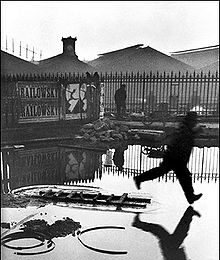
A startling Cartier-Bresson image
taken with his famous  LEICA
Then I looked again at the life works of Cartier Bresson. Cartier Bresson is still the master of street photography--and he did just so much of his great work on a small, unobtrusive LEICA he carried in his pocket. The trick is to be invisible to your subjects so they don't play for the camera.  For sports photography, that is easy but to capture the quick of life, it is much harder.
Big battery blister on my S2 gives sufficient
life for a day's shooting, navigation and
emailing
Consequently, at the beginning of this year, I made the decision not replace my worn out Pentax DSLR with its beautiful Tamron 18-200mm zoom lens to travel with a smartphone. The best available at the time was the Samsung Galaxy S2.
It was the right move, I took nearly 3000 photos in four months and, every night was able to review what I had to match with my writing. Many of the photos were note taking rather than story telling, there to remind me of the text on signs, people and places visited. Thus my writing improved along with my photography.
But as my expertise grew, so did my frustration with the limitations of using a single device for everything. For example, you can't record a public speech and take photos at the same time. The killer was that, like most multi-use tools, the performance of some functions can be mediocre.  On the S2's camera, I began to notice a subtle pink spot at the centre of each snap. At first, I just worked around the difficulties with post-production fixes on my home computer but finally I cracked.

The Smart Camera

Sadly, while coming with a thoughtful camera app
that works on startup, the camera has annoying
number of junk apps baked in.
Cue the Galaxy Smart Camera with its 16MP, Optical 21x, 23mm Wide Zoom lens.
Samsung took a moderately good compact camera (Samsung WB850F) ripped off the complicated array of buttons and dials and layered onto the back the touch screen and guts of arguably one of the best smart phones available the Galaxy S3.  If you want to read a proper description  of this remarkable package see Digital Photography Review
The only bit Samsung left out from the S3 was the ability to do voice phonecalls--not a high priority when you already have a smartphone on you. My experience of trying to use a smartphone is one of horrific battery drain--and with only a tiny 1,650mAh battery you just don't need that pain. The trick is, as I quickly found out, to limit it to its proper function--a good camera with excellent communication and reasonable editing.
Then there is the weight and size.  The specs say 300gm which is over twice that of the S3.  And you will need to carry a spare battery. Still that is much less than even the lightest of the DSLRs currently on offer and it is compact enough to be worn on a belt.
In a rather ironic twists,  the ergonomics are great for me because I am a left hander. The camera grip, zoom and photo button are on the right and easy to use but my dominant hand is free to use the screen better than the majority of people.  Very much the same as a table setting: never did really understand why the fork, the most used implement is on the left but it suits me perfectly.
But it is in the comms that this phone shines.  More on that later as I work towards what is the best configuration for my purposes.
Like death and taxes, the gullible are always with us

Protestors in the Capital. Now the horned man, Jacob Chansley says he’s coming to terms with events leading to the riot and asked people to ...